
stoa coffee
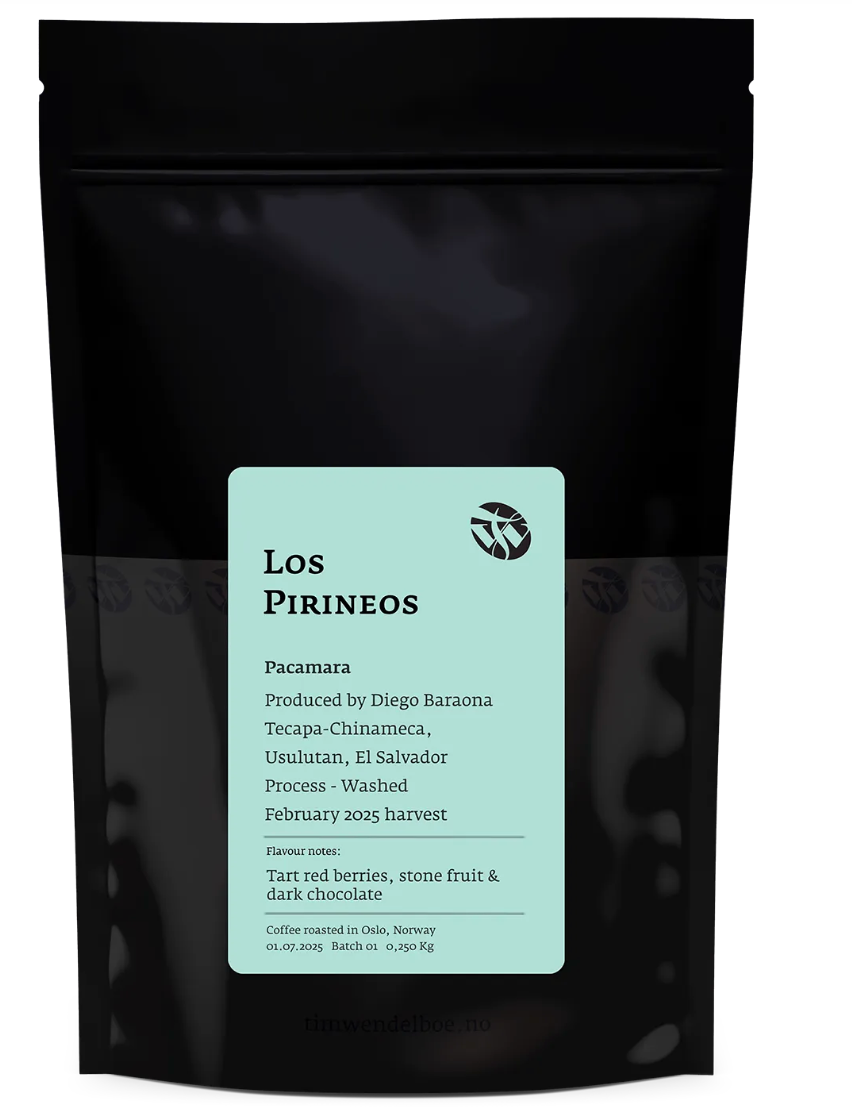
Tim Wendelboe - Los Pirineos - (El Salvador, Washed, Pacamara)
Tim Wendelboe - Los Pirineos - (El Salvador, Washed, Pacamara)
Couldn't load pickup availability
Tasting Notes: Tart red berries, stone fruit & dark chocolate
An intense and fruity Pacamara coffee with notes of tart red berries, stone fruit & dark chocolate.
| Cultivar |
Pacamara |
|---|---|
| Flavour Notes |
Tart red berries, stone fruit & dark chocolate |
| Producer |
Diego Baraona |
| Country |
El Salvador |
| Region |
Tecapa-Chinameca, Usulutan |
| Process |
Washed |
| Harvest |
February 2025 |
| Roast Profile |
Light Roast |
| Contents |
Whole Coffee Beans |
| Bag Size |
250g |
Tim's Notes
With complex tart red fruit flavours, notes of stone fruit and structured acidity, this is a great example of how complex a washed Pacamara can be. There is a good reason why Los Pirineos has won so many awards for their Pacamara coffees.
Often times you hear that Pacamara coffees can be a bit herbal or oniony in flavour, and I don’t disagree, but this coffee has none of those off-flavours. There are so many versions of Pacamara being planted as the cultivar is not uniform, probably because it was released before it was stabilised as a new cultivar. Maybe that is why there are so many different flavour profiles of this cultivar as well.
In my experience the Pacamara coffees from Los Pirineos always taste good and rarely have any of those weird flavours. I believe this is because Los Pirineos was in fact one of the farms involved in the development of the cultivar and the team was able to select a good line for the farm. Today Diego produces high quality certified Pacamara seeds that he also sells to other farmers.
Cultivar
Pacamara is a crossing between Pacas and Maragogipe that can have very interesting cup profiles. It was released to farmers around El Salvador a bit early before it was a stable cultivar. It means you will get different outcomes when you plant the seeds from existing plants which means you can find really great tasting ones and some that are not so tasty. For many years our friend and coffee farmer Gilberto Baraona planted a great selection of Pacamara on his farm and he was able to get numerous top 10 placements at the El Salvador Cup of Excellence before he passed away. Fortunately his son, Diego is carrying on his legacy and continue to produce top quality Pacamara coffees.
Process
Picking and sorting
- All cherries are selectively picked by hand. Unripe and damaged cherries are removed by hand from the ripe cherries before processing.
Depupling, fermenting & washing
- Coffee cherries are de-pulped before they are dry-fermented over night. The next morning, the mucilage is washed off the parchment coffee before the coffee is taken to the drying beds.
Drying
- The coffees we buy from Los Pirineos are all dried slowly on raised beds and most beds are covered with shade nets. During drying the coffees are raked throughout the day to ensure even drying. At night it gets covered to prevent condensation and the risk of the coffee gaining moisture in the drying process. Once the coffees are dried, they are stored in air tight grain pro bags before the they get milled and sorted on the farm. The coffees are also packed in vacuum packs on the farm before they are shipped to Norway.
Share